
Key points
- Shopify, Shopware or headless: we choose the platform based on your range and workflows.
- Fast even during campaign peaks, with an eye on Core Web Vitals.
- Connected to ERP, shipping, payment providers and accounting.
- Order, invoice, shipping label and tracking email run without manual steps.
- Planned in stages: a usable version first, then expansion.
Shopify, Shopware or headless?
There is no single right shop platform. The choice depends on what you sell, how many products you have and which systems are already in place.
- Shopify fits if you want to launch quickly and your team should manage the shop without technical know-how.
- Shopware fits if you need lots of variants, B2B pricing or tight integration with your inventory system.
- Headless fits if design and speed come first. We build a custom front end while the shop platform delivers products and orders in the background.
In the intro call we look at your range and your workflows. Then you get a clear recommendation. Even if it is: your existing shop is fine, it just needs to get faster.
Orders without manual work
In many shops the manual work starts after checkout: copy the order into the ERP, write the invoice, print the shipping label, inform the customer. We connect your shop so these steps run on their own.
- Payment, stock and delivery address are checked automatically.
- The order goes to ERP and accounting, the invoice is created automatically.
- Shipping label, tracking email and status updates go out without lifting a finger.
- Customer accounts, review requests and reorder reminders bring customers back.
Fast, visible and safely migrated
A slow shop costs revenue, especially on mobile. We optimise images, scripts and hosting for short load times and keep an eye on Core Web Vitals. Product and category pages get structured data so Google understands prices and availability. Read how we approach this on our SEO agency page.
If you’re moving from an old shop, every old product URL gets its new destination. That way your rankings come along for the migration.
How it works: building your online shop
We plan online shops in stages. A usable version goes live first, then the shop grows with your requirements.
- 01
Intro call
30 minutes on a video call: product range, target group, existing systems and goals. You get an honest assessment of which platform fits.
- 02
Concept & quote
Shop structure, design direction and the planned order flow from checkout to shipping. Plus a quote with a clear scope.
- 03
Shop & integrations
We build the shop and connect it to ERP, payment provider, shipping and accounting. You test previews and sign off.
- 04
Go-live
Test orders, redirects for old URLs, domain and DNS migration. Then the shop goes live.
- 05
Growth & support
Hosting, monitoring, updates and new features as needed. You reach us directly, with no ticket system.
How much does an online shop cost?
The cost depends mainly on the platform, the number of products and the integrations. A shop with a standard checkout is quicker to build than one with ERP integration and B2B pricing. Typical projects:
- Shopify shop with custom design
- Shopware shop with ERP integration
- Headless shop with custom front end
- Hosting, maintenance & support per month
Prices on request: every project is different, so the price depends on the scope.
Whether licence or subscription fees apply for the shop platform depends on the system. It’s all spelled out in the quote you receive after the intro call. No hidden costs.
Case study: Zeitblick
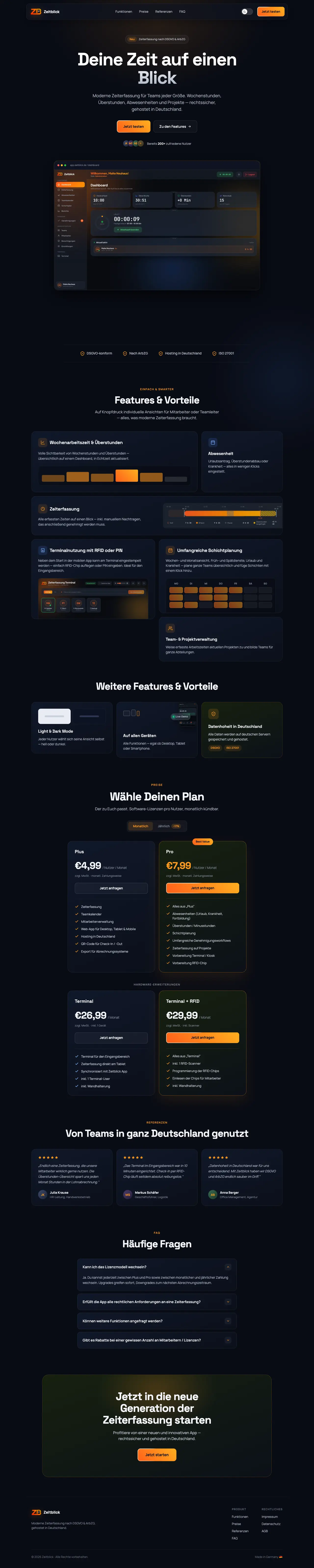
- Web app
- Product website
- RFID terminal
- Hosted in Germany
Zeitblick isn’t a classic online shop, but the principle is the same. The product site sells licences, while the actual product is the time-tracking web app behind it. Website and application work together instead of side by side. That’s how we connect shops to the systems behind them: a purchase turns into an active customer without detours.
Frequently asked questions
Shopify or Shopware: which one is right for me?
Shopify suits a quick start with little day-to-day technical effort. Shopware plays to its strengths with many variants, B2B pricing and tight ERP integration. In the intro call we recommend the platform that fits your range and workflows.
How long does it take to build an online shop?
We plan online shops in stages. A usable version goes live first, then the shop grows with your requirements. You get a realistic timeline in the intro call.
Can you connect our shop to our ERP?
Yes. Orders go to ERP and accounting, the invoice is created automatically. If there’s no ready-made interface, we build one.
Do you handle the move from an old shop?
Yes. Every old URL gets its new destination via a 301 redirect. We move your domain, DNS and mailboxes as well. That way you lose neither rankings nor emails.
Will the shop stay fast during campaigns?
That’s what we build it for. We optimise images, scripts and hosting for short load times and keep an eye on Core Web Vitals so the shop stays fast even during campaign peaks.
Who looks after the shop after launch?
We do. Hosting, monitoring, backups, updates and new features. You reach us directly, with no ticket system and no hold music.