
Key points
- Customer portals, internal tools, dashboards and specialist applications.
- Single sign-on with Microsoft or Google, two-factor and permissions per team, location and client.
- Encrypted data, a log of every change and a security review before every release.
- Hosting in Germany and the EU, data processing agreements and deletion policies included.
- Clean documentation so you never depend on us.
When custom software pays off
Off-the-shelf software is often the right choice. It stops fitting when your team copies data back and forth between three tools, customers send documents by email or a spreadsheet has quietly become the most important application in the company. Then the gap between software and process costs time every single day.
A business app closes that gap. It’s built for your workflow, not the other way round. And it talks to the systems you already have.
Having a customer portal built
A customer portal is often the biggest lever. Customers upload documents, see the status of their order or book appointments. Your team answers fewer questions because everything is in one place.
A portal becomes especially powerful when it’s connected to your website. An enquiry automatically creates the customer in your CRM. Once the quote is signed, they get access to the portal, a welcome email and a kickoff appointment. That’s what automated customer onboarding looks like, as we show on our home page.
What “enterprise level” means in practice
- Single sign-on & roles: sign in with Microsoft or Google, two-factor, fine-grained permissions.
- Security by design: encrypted data, a log of every change, security reviews before every release.
- Scales with you: cloud-native architecture that grows from ten to ten thousand users without a rebuild.
- Integrations: APIs and webhooks to CRM, ERP, accounting and Microsoft 365.
- EU hosting & GDPR: data centres in Germany and the EU, data processing agreements and deletion policies.
- No lock-in: monitoring, backups, updates and documentation that keeps you independent.
How it works: from idea to running app
We plan business apps in stages. A usable version goes live first, then it grows with your requirements.
- 01
Intro call
30 minutes on a video call. We talk about your workflow, your users and the systems already in place.
- 02
Concept, MVP & quote
Process flow, roles and integrations at a glance. Before the actual collaboration starts, we build an MVP (a small usable demo), so you see early how your app could look and what we can do. Then you get a quote with a clearly defined scope for the first stage.
- 03
First usable version
We build the core of the app and connect the most important systems. You see regular previews and sign off.
- 04
Go-live
Security review before release, then real users start working with the app.
- 05
Further development
Monitoring, backups, updates and new features as needed. With documentation that keeps you independent.
How much does a business app cost?
The cost depends on the number of users, roles, integrations and security requirements. An internal tool for one team is smaller than a customer portal with single sign-on and ERP integration. Typical projects:
- Internal tool or dashboard (first stage)
- Customer portal with login, roles and documents
- Specialist application with several integrations
- Hosting, operation & development per month
Prices on request: every project is different, so the price depends on the scope.
Because we build in stages, you get a separate quote with a clear scope for the first usable version. No hidden costs.
Case study: Zeitblick
- Business app
- MVP
- Web & mobile
- RFID terminal
- Hosted in DE
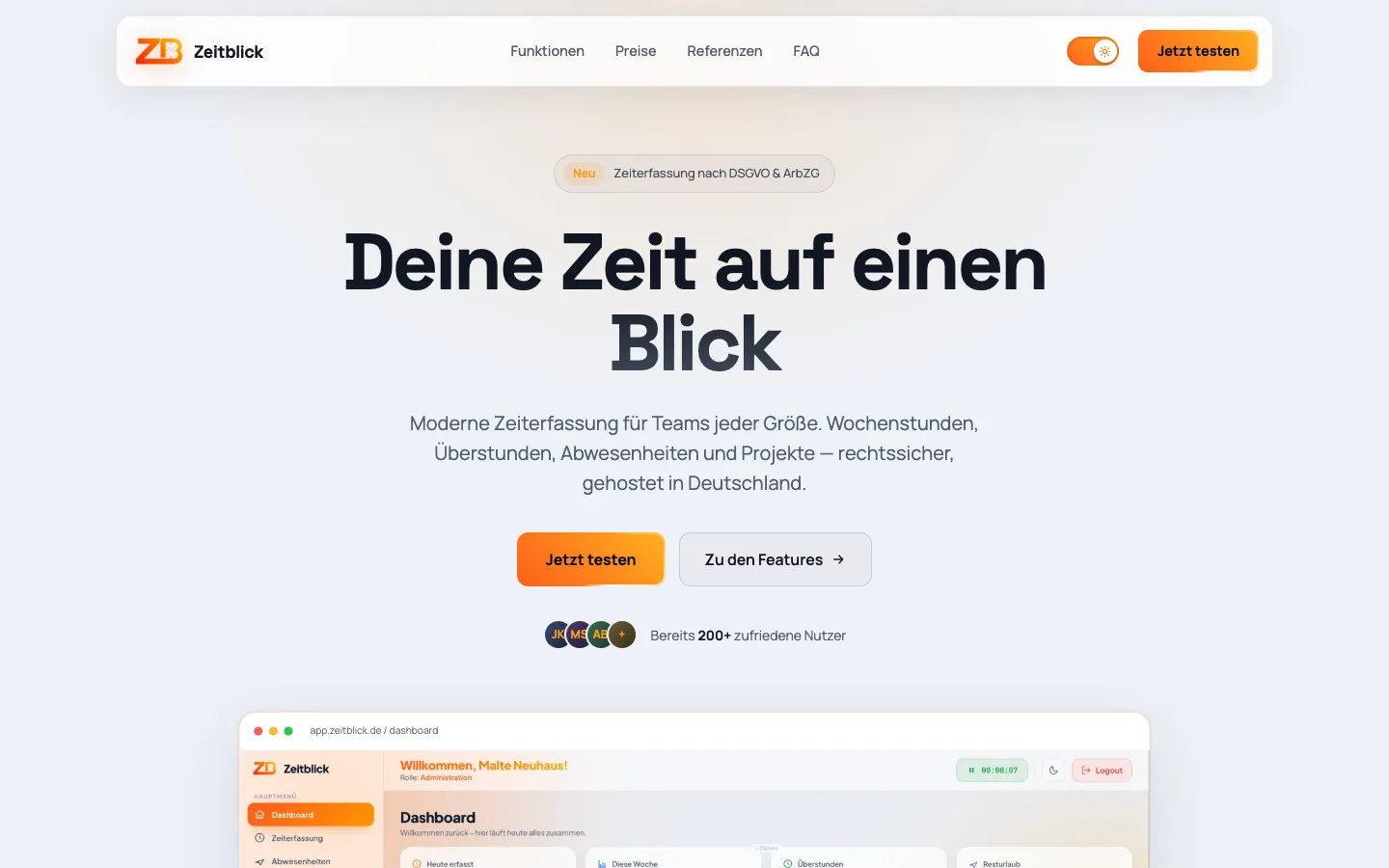
Zeitblick started as an individual business app. A social care organisation and a trade business could not find time tracking on the market that met their requirements and was hosted in Germany. We started with an MVP and developed it into the finished app. Because many businesses share the same problems, it has become a product of its own for SMEs.
Frequently asked questions
How much does custom software development cost?
It depends on users, roles, integrations and security requirements. We quote prices on request, as they depend on the scope of the project. After the intro call you get a transparent quote.
How long does development take?
We plan in stages. A usable version goes live first, then the app grows with your requirements. You get a realistic timeline in the intro call.
How secure are your business apps?
We build to the standards we know from large corporations: single sign-on, roles and permissions, encrypted data, logging, EU hosting and regular security updates. And we document everything so you don’t depend on us.
Can the app talk to our existing systems?
Yes. Using APIs and webhooks we connect it to CRM, ERP, accounting, Microsoft 365 and Google Workspace. If there’s no interface, we build one.
Where is the data stored?
In data centres in Germany and the EU. Data processing agreements and deletion policies are part of it.
Will we depend on you afterwards?
No. We’re happy to handle monitoring, backups and updates. But we document everything properly so you never depend on us.
Is a customer portal worth it for smaller companies?
Often especially then, because a few people answer a lot of questions. We build at the size that fits you. The app can be extended later.